
Diamond Clarity Chart: Every Grade from FL to I3
A visual diamond clarity chart for all 11 GIA grades, from Flawless to I3. See the inclusions typical of each grade, how to read a clarity plot, which grades are eye-clean, and which clarity gives the best value.
By Rafi Mizrahi, diamond dealer for 26 years
Clarity grades how free a diamond is from internal inclusions and surface blemishes. GIA grades it on an 11-step scale, judged by a trained grader looking at the diamond under 10× magnification — not by eye. Almost every natural diamond has inclusions; what changes from grade to grade is how many there are, how big they are, and how easily they can be seen. Clarity is one of the 4Cs, alongside cut, color and carat.
Diamond Clarity Chart
The chart below shows a typical clarity plot for each grade — a top-down diagram of a round brilliant diamond with its inclusions drawn in red, the way GIA maps them on a grading report. The marks grow from none at Flawless to large, numerous inclusions at I3.
Flawless
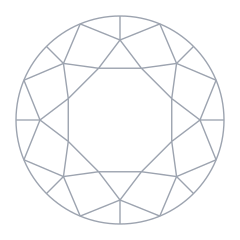
FL
Flawless
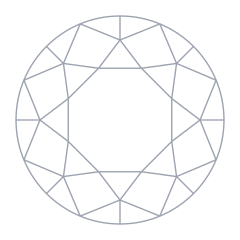
IF
Internally Flawless
Very Very Slightly Included
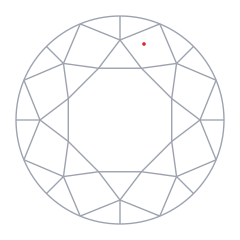
VVS1
Minute inclusions, extremely hard to find even under 10× magnification
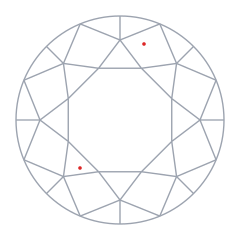
VVS2
Minute inclusions, very hard to find under 10× magnification
Very Slightly Included
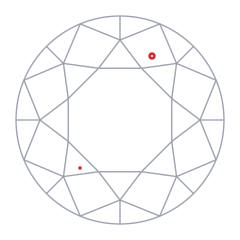
VS1
Minor inclusions, seen with effort under 10×
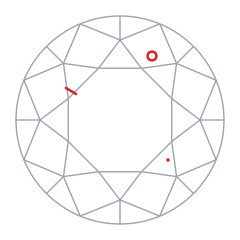
VS2
Minor inclusions, fairly easy to see under 10×
Slightly Included
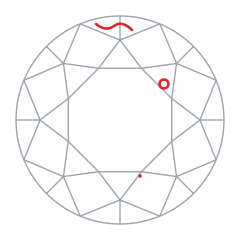
SI1
Noticeable under 10×
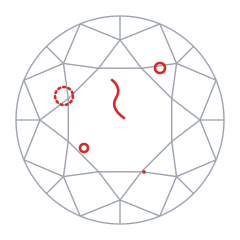
SI2
Easy to see under 10×
Included
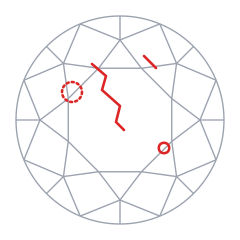
I1
Obvious under 10× and often visible to the naked eye
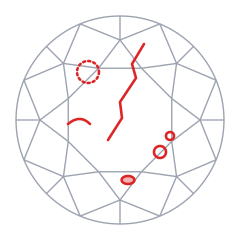
I2
Visible to the naked eye; can reduce sparkle
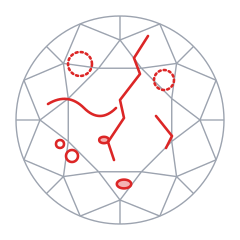
I3
Clearly visible; can affect sparkle and durability
Illustrations of typical inclusions at each grade. Every diamond's plot is unique; the one on its GIA report shows its actual inclusions.
The Clarity Grades, Group by Group
GIA groups the 11 grades into six categories. From best to worst:
- •Flawless (FL) — No inclusions and no surface blemishes visible under 10× magnification. Extremely rare and priced accordingly.
- •Internally Flawless (IF) — No inclusions under 10× magnification; only minor surface blemishes, often removable by repolishing.
- •Very Very Slightly Included (VVS1, VVS2) — Inclusions so small they are extremely difficult (VVS1) to very difficult (VVS2) for a skilled grader to find under 10×. Typically pinpoints or tiny crystals.
- •Very Slightly Included (VS1, VS2) — Minor inclusions that range from difficult (VS1) to somewhat easy (VS2) to see under 10×. Almost always invisible to the naked eye.
- •Slightly Included (SI1, SI2) — Inclusions noticeable under 10×, such as small feathers, crystals or clouds. SI1 diamonds are usually eye-clean; SI2 diamonds sometimes show an inclusion to the naked eye.
- •Included (I1, I2, I3) — Inclusions obvious under 10× and usually visible to the naked eye. At I2 and I3 they can reduce transparency and sparkle, and large feathers can affect durability.
How to Read a Clarity Plot
Every GIA grading report for a diamond of about 1 carat and up includes a clarity plot: a diagram of the diamond from the top (crown) and bottom (pavilion), with each clarity characteristic drawn at its approximate position and size. Red symbols are internal inclusions; green symbols are external blemishes. The report also lists the key inclusions by name, in order of how much they affected the grade. (More on the rest of the report in understanding your GIA certificate.) The most common symbols:
- •Pinpoint — A tiny crystal that looks like a dot under 10×. On its own it rarely matters.
- •Crystal — A mineral crystal trapped inside the diamond. Usually white or clear; dark crystals are easier to see.
- •Cloud — A cluster of pinpoints. Small clouds are harmless; large ones can make a diamond look hazy.
- •Feather — A small break inside the diamond. Small feathers are common; long ones that reach the surface can be a durability risk.
- •Needle — A long, thin crystal. Looks like a short line on the plot.
- •Cavity — An opening at the surface, often where a crystal broke away during polishing.
What Eye-Clean Means
A diamond is eye-clean when you can't see any inclusion without magnification, looking face-up from a normal viewing distance. VS2 and most SI1 round diamonds are eye-clean; SI2 depends on the stone. Where an inclusion sits matters as much as the grade: a feather under the table (the large top facet) is far easier to see than the same feather near the girdle, where the facets hide it. Step cuts such as emerald and Asscher have large open facets that show inclusions more easily, so buyers usually go a grade or two higher in those shapes. Larger diamonds show inclusions more easily too.
Which Clarity Grade Gives the Best Value?
Price climbs steeply up the clarity scale, but beyond eye-clean you're paying for differences only a grader with a loupe can see. For round brilliants the sweet spot is usually VS2 to SI1: eye-clean in most cases and priced well below VVS. For step cuts, aim for VS1–VS2. Within a grade, compare the plots: an SI1 with a small white crystal near the edge can look cleaner than a VS2 with a dark crystal in the middle of the table. Put the money you save into cut quality, which has a far bigger effect on how a diamond looks.
- •Round brilliant — VS2–SI1 for the best balance of looks and price.
- •Emerald, Asscher and other step cuts — VS1–VS2, since inclusions show more easily.
- •Avoid — Inclusions under the table, dark crystals, and long feathers that reach the surface, at any grade.
Check a Diamond's Clarity
Enter a GIA certificate number to see the diamond's clarity grade, its actual clarity plot from the report, and how the inclusions affect its price. Our quality checks call out the inclusions that matter — like a feather under the table — and which ones are typical for the grade.
Check a diamond's clarity and price →